BRICS Nations Adopt New Delhi Declaration After Overnight Talks on West Asia
THE DECLARATION
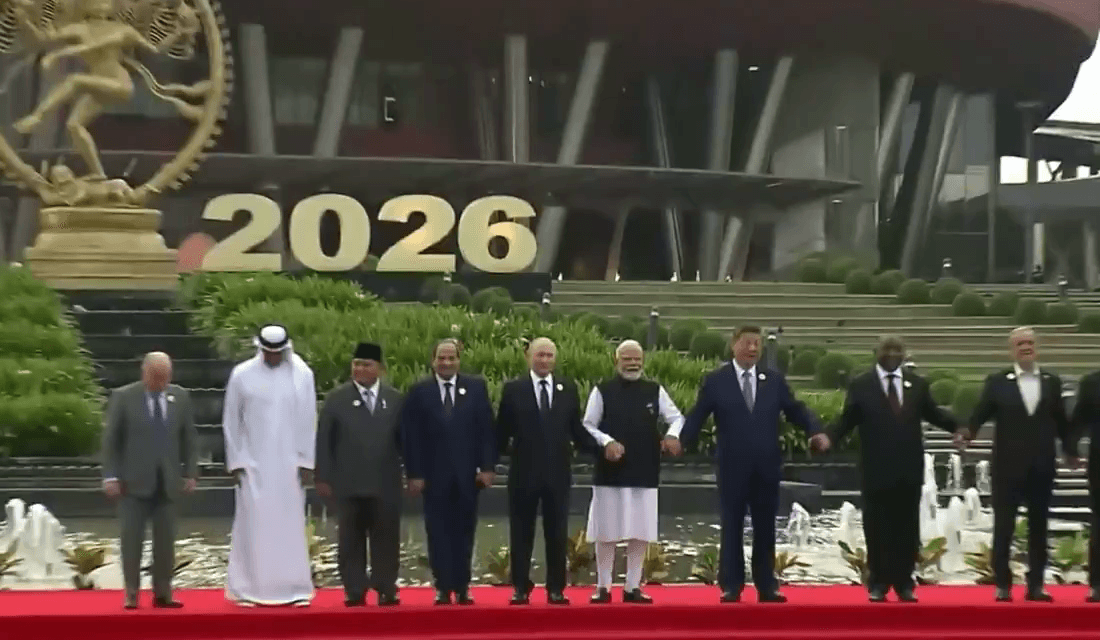
Leaders of the ten-member BRICS bloc gathered at Bharat Mandapam in New Delhi on Saturday for the 18th BRICS Summit, posing for the traditional family photo beneath a golden Nataraja statue and a "BRICS 2026" sign before adopting the New Delhi Declaration 2026. Prime Minister Narendra Modi, hosting the summit as India holds the rotating BRICS chair for the year, announced the outcome himself: "No member has raised any objection. The New Delhi Declaration 2026 is adopted unanimously." The leaders followed the declaration's adoption with a joint tree-planting ceremony on the venue's lawns.
THE OVERNIGHT FIGHT OVER WEST ASIA
The unanimous outcome masked a far messier path to get there. With Iran, Saudi Arabia and the United Arab Emirates all in the room, each carrying its own position on the region's conflicts, negotiators could not agree on how the declaration should describe West Asia. BRICS Sherpas stayed up negotiating language until 4 a.m. on the morning of the summit itself, and people close to the talks described it as the single hardest sticking point of India's entire chairship. The text that finally emerged calls for conflict prevention that addresses root causes, commits members to resolving disputes through dialogue rather than force, and stresses a multilateral approach that respects each country's own position rather than forcing a single line. Reaching consensus among a bloc that now includes historic regional rivals is itself the story: a joint statement that satisfies Tehran, Riyadh and Abu Dhabi at once is not something any single paragraph can do without real compromise behind it.
WHAT'S ACTUALLY IN IT
Beyond the diplomacy, the declaration commits BRICS to a specific, if lengthy, agenda. It backs reform of the UN Security Council, with China and Russia explicitly reiterating support for India and Brazil's long-standing bids for permanent seats. It calls for reforming the IMF and World Bank so voting power better reflects the size of developing economies, and for expanding trade settled in local currencies alongside new, interoperable payment systems that reduce reliance on existing global financial rails. The New Development Bank, BRICS's own lender, is positioned to take on a bigger role funding infrastructure in members' own currencies. On food security, the bloc advanced plans for a BRICS Grain Exchange and a companion initiative called AGRIN aimed at cushioning members from price shocks. The declaration also pushes back directly on trade measures from outside the bloc, criticizing unilateral tariffs, secondary sanctions and carbon border taxes as unfairly burdening developing economies. On security, it condemns terrorism in all forms and specifically names last year's attack in Jammu and Kashmir, alongside a renewed push for a long-stalled UN treaty on international terrorism. A section on technology commits members to cooperating on trustworthy AI governance and a shared digital public infrastructure repository.
WHO WAS THERE, WHO WASN'T
Modi hosted alongside Chinese President Xi Jinping and Russian President Vladimir Putin, with Egypt's Abdel Fattah El-Sisi, Indonesia's Prabowo Subianto, the UAE's leadership and other heads of state and government filling out the family photo lineup. One notable absence: Brazil's President Luiz Inacio Lula da Silva skipped the summit in person, with Brazil represented instead by its foreign minister, Mauro Vieira.
WHAT'S NEXT
With the declaration adopted, BRICS's rotating chairship passes to China, which will host the 19th summit in 2027. For India, pulling a unanimous statement out of a bloc containing some of the world's sharpest regional rivalries is being read in New Delhi as a genuine diplomatic win for its year in the chair, whatever the document's language ultimately amounts to in practice.
Source: The Tribune